
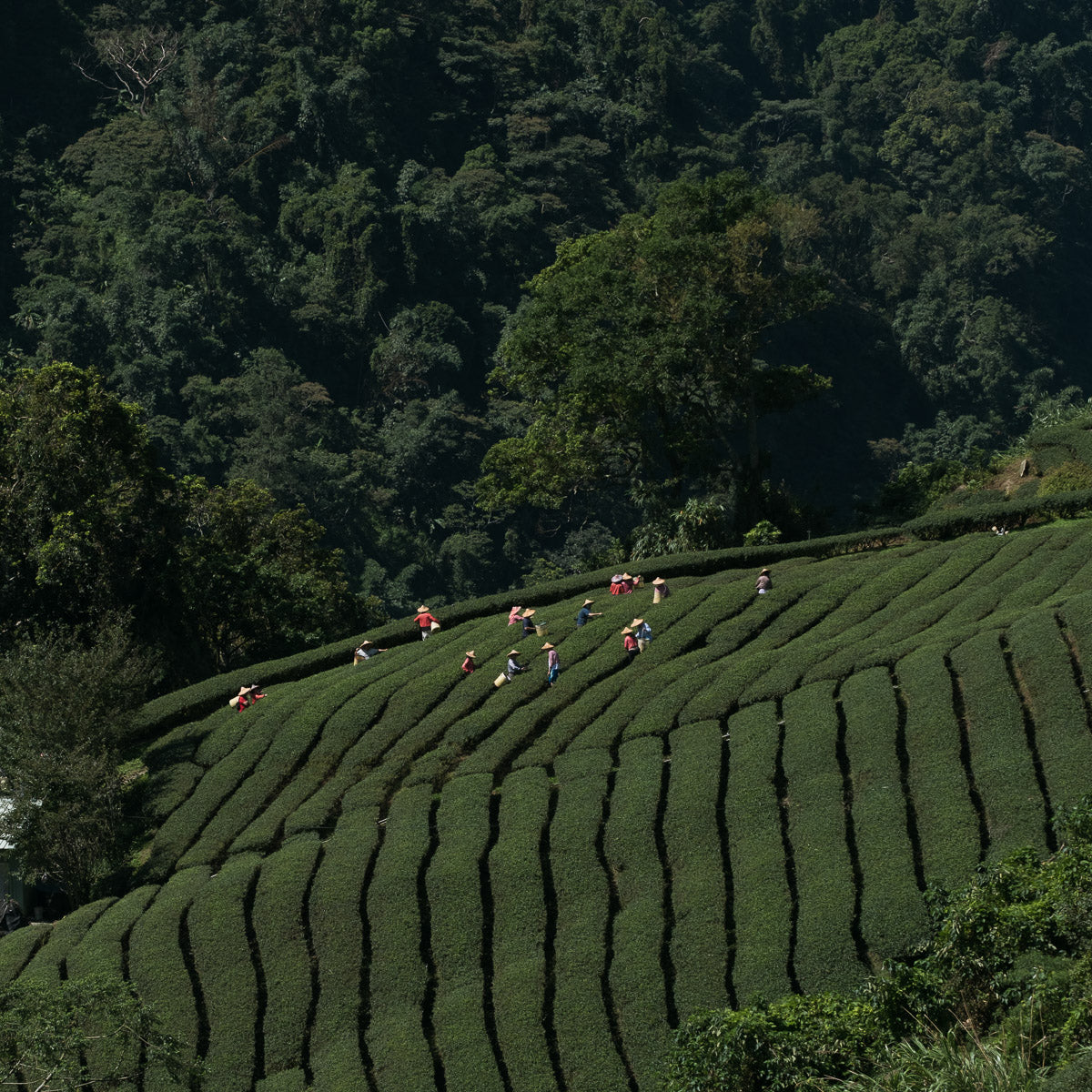
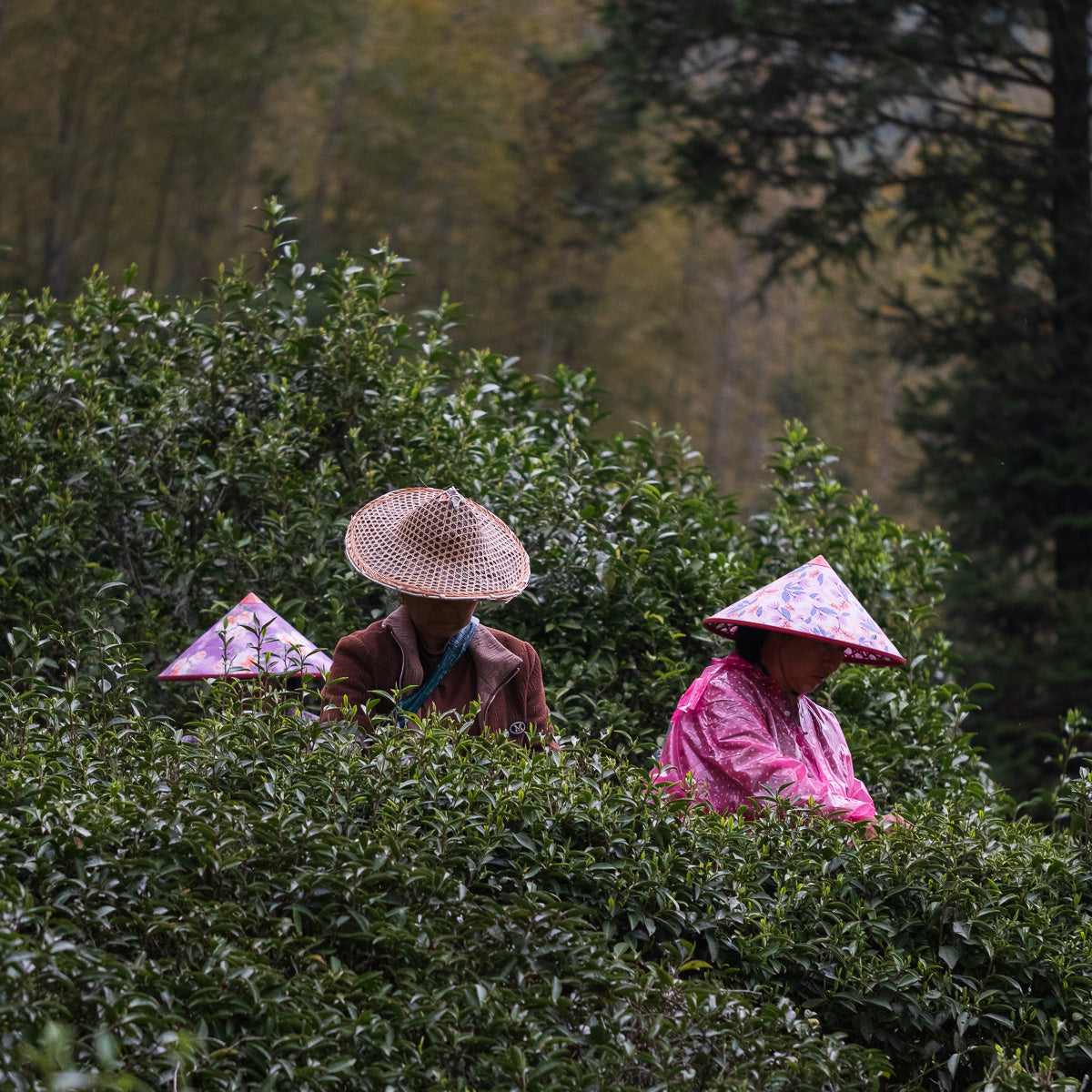

Last August, during our sourcing trip to Taiwan, finding Tie Guan Yin oolong was high on our list. Just two days after arriving in Taipei, we headed straight to Muzha in search of this tea. Most people associate Tie Guan Yin with Anxi in Fujian, China, where it originated and is still widely produced today. So why look for it in Taiwan? And why Muzha?
There’s more to Tie Guan Yin than most people realise.
What is Tie Guan Yin and what does it actually refer to?
When people speak of Tie Guan Yin (铁观音), most are referring to the famous oolong tea originating from Anxi, Fujian, China, with a history dating back to the 18th century. This is technically correct.
What is less widely known is that Tie Guan Yin also refers to the original tea plant cultivar used to produce it. This cultivar is known as Hongxin Waiweitao (红心歪尾桃) in both China and Taiwan. It is characterised by a reddish bud base and slightly crooked leaf tips resembling a peach, which gives the cultivar its name.
Among tea farmers, the Tie Guan Yin cultivar is valued for its distinctive flavour but it is also known for being demanding to grow and maintain. For this reason, many producers in Anxi have gradually shifted toward newer cultivars such as Jin Guanyin (金观音). In Taiwan, cultivars like Jin Xuan (金萱) or Si Ji Chun (四季春) are often processed in the Tie Guan Yin style instead.
Even when produced using the same Tie Guan Yin processing techniques, these teas often lack the same depth or the long, lingering sweetness found in the original Hongxin Waiweitao cultivar.
From Anxi to Taiwan: how Tie Guan Yin found a new home
So, back to the question raised earlier: why Muzha?
The Muzha area is one of Taiwan’s earliest tea-producing regions. During the mid-19th century, immigrants from Fujian brought tea plants and cultivation knowledge with them, including the original Tie Guan Yin cultivar from Anxi. The local environment proved well-suited for its cultivation, allowing the tea to establish itself successfully in the region.
As many of these early settlers came from Anxi, Tie Guan Yin production in Muzha developed as a continuation of family traditions. Techniques were passed down within tea-growing families, preserving the traditional style of high oxidation and heavy roasting – methods that are difficult to learn and even harder to master.
This traditional approach has largely continued in Muzha to this day, with some variations between producers. This contrasts with Anxi, where since the 1980s, the dominant style of Tie Guan Yin shifted toward lighter oxidation and a greener, more aromatic profile. However, in recent years, we have also seen a growing number of Anxi producers returning to more traditional processing.
For this reason, travelling to Muzha in search of traditionally made Tie Guan Yin oolong feels almost like opening a preserved chapter of the tea’s history.
The taste of Tie Guan Yin oolong
Although the Tie Guan Yin cultivar, Hongxin Waiweitao, has a distinctive character of its own, its expression evolves with the environment in which it is grown. Terroir and local climate play a key role in shaping the tea’s final profile. In general, traditionally made Tie Guan Yin oolong from this cultivar is known for its mellow sweetness, depth, rounded body, floral aroma, and a pleasing mineral touch on the palate.
At first, the tea can feel understated, even simple. Then, after a few moments, a layered sweetness begins to appear, followed by light fruity notes and a lingering floral aroma. The texture is smooth, leaving a soft and comfortable sensation in the throat – this full experience is what is known as Guanyin Yun (观音韵). This sensation is what first made us fall for Tie Guan Yin, and why we keep coming back to it. It’s also exactly what we found again when brewing this Muzha Tie Guan Yin oolong sourced during this trip.
Quick tips: How to brew Tie Guan Yin oolong
Since we’ve covered quite a lot about Tie Guan Yin, this post wouldn’t be complete without a few tips for brewing it in the Gongfu style.
- Tea vessel: Our go-to is a Yixing teapot, but for a more versatile option, a glazed ceramic teapot works well too.
- Tea-to-water ratio: About 7 g of tea per 100 ml of water.
Brewing steps:
- Warm the teapot: Pour boiling water into the teapot, then discard it. Add the tea leaves and let them absorb the heat for 10–20 seconds. Once warmed, this is a perfect moment to take a deep sniff and enjoy the aroma.
- Quick rinse: Use water at 98 °C for a very brief rinse, then start the first infusion at 98 °C for around 40 seconds.
- Subsequent brews: Use boiling water at 100 °C, adding about 10 seconds to the infusion time for each round. To keep the temperature steady, you can pour hot water over the outside of the teapot while the tea steeps. The goal is to maintain high heat to fully bring out the flavours and aromas from the leaves.
And that’s how we enjoy Tie Guan Yin at Tedelics. Curious about oolong teas? Check out our full oolong tea collection – there’s a lot to explore.